Notice that registration is now open for the 6th Annual London & Region FASD Virtual Conference on October 20 and 21, 2026.
Help Improve Mental Health Care for Youth and Young Adults with Fetal Alcohol Spectrum Disorder (FASD)
Researchers at the University of Calgary are looking for youth and young adults with FASD to take part in an individual interview to share their perspectives about how health professionals can identify and support young people with FASD struggling with thoughts of suicide.
Interviews will last about 30 to 45 minutes and can be done over Zoom, by phone, or in person (in Calgary, AB). Participants will receive a $50 gift card to thank them for their time.
They are looking for people:
- Between the ages of 16 and 30 years
- With a formal diagnosis of FASD by a registered health provider
- Who are Canadian residents
- Who have experienced suicidal thoughts or behaviours
This research study is being conducted by investigators at the University of Calgary (Drs. Carly McMorris and Dorothy Badry), the University of Alberta (Dr. Jacqueline Pei), and the Canadian FASD Research Network (CanFASD; Dr. Kelly Harding, Audrey McFarlane, and Kathy Unsworth).
It is funded by the Canadian Association of Suicide Prevention (CASP) and has been approved by the University of Calgary’s Conjoint Faculties Research Ethics Board (CFREB; REB23-0933).
To see if you are eligible to participate, and to express your interest, please answer the questions at this link: https://survey.ucalgary.ca/jfe/form/SV_2iCDvohDpeuO6O2
New FASD Breastfeeding Support Group
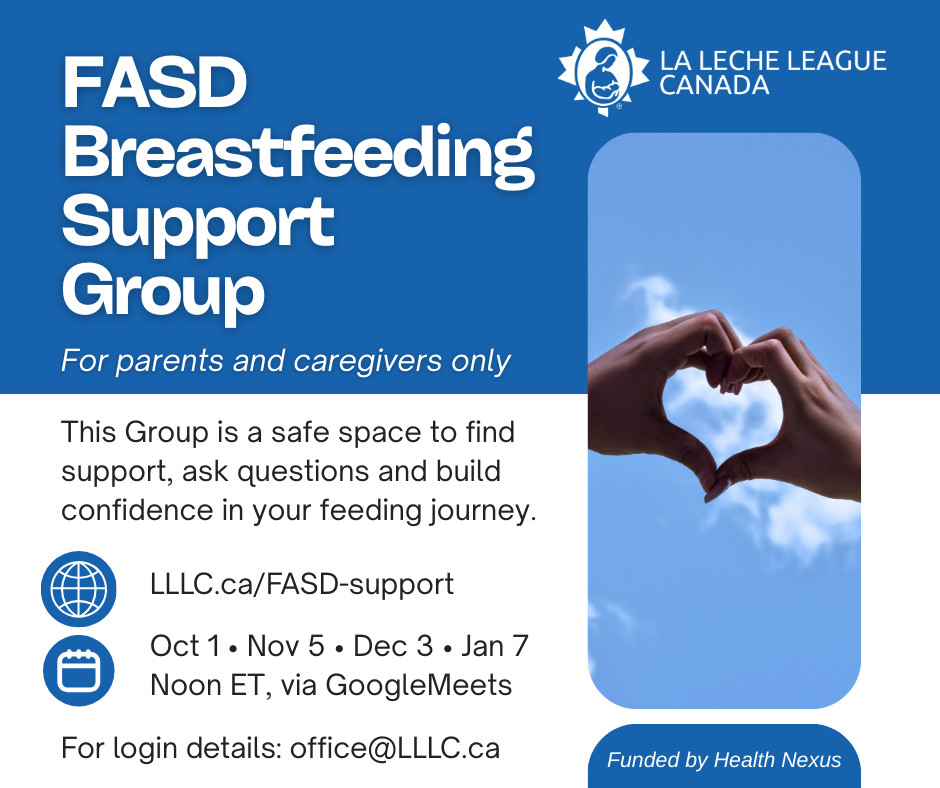
La Leche League Canada is pleased to announce a new FASD Breastfeeding Support Group for families who are breastfeeding or providing human milk to a child with Fetal Alcohol Spectrum Disorder (FASD).
This group is designed as a safe and welcoming space for parents and caregivers only. It offers support, connection, and evidence-based information tailored to families navigating FASD and human milk feeding.
Meeting Dates:
- October 1
- November 5
- December 3
- January 7
Time: Noon ET
If you know families who may benefit from this group, we encourage you to share this information with them.
For login details, please email office@LLLC.ca
Funding for this group, as well as an upcoming toolkit for healthcare
Self-Care Strategies Resource Booklet
CanFASD recently published a Self-Care Strategies Resource Booklet to support wellbeing for caregivers. Please see attached pdf or access via https://canfasd.ca/wp-content/uploads/publications/Self-Care-Strategies_WebResource_Oct2025.pdf . Please feel free to download it and/or share with anyone you think would benefit from this guide.
As discussed in the guide, “…Self-care is a life-long practice focused on building our knowledge and experience to care for our health and wellbeing. Building self-care habits and routines can be challenging but can ultimately help improve our lives. Self-care looks different for everyone, and it’s important to find options that works for you. This resource provides a list of potential self-care activities to support the health and wellness of caregivers of individuals with FASD. These strategies were compiled as part of the Caregiver Approaches, Resiliencies, and Experiences (CARE) Study…”
To learn more about the CARE study, please watch this Health Nexus webinar: https://www.fasdinfotsaf.ca/webinars/results-caregiver-approaches-resiliences-experiences-care-study/.
CanFASD Needs Assessment on Prenatal Alcohol Exposure and Fetal Alcohol Spectrum Disorder
The Canada Fetal Alcohol Spectrum Disorder Research Network (CanFASD) is inviting all professionals and service providers involved in the FASD diagnostic process (including those screening for FASD and making referrals for assessment) to participate in a needs assessment survey about prenatal alcohol exposure and Fetal Alcohol Spectrum Disorder. This survey will take 10-15 minutes to complete: all responses will be confidential, reported only in aggregate, and you may skip questions as needed.
Any responses will inform the development of a virtual information hub about prenatal alcohol exposure and fetal alcohol spectrum disorder—alongside other future initiatives to update clinical guidelines, referral and diagnostic systems, policies and provider training.
Please feel free to forward this email to your networks; we welcome any perspectives from those involved in the diagnostic process.
You can find the survey:
We ask that you please fill out this survey by January 26th, 2026.
If you have any questions or extra input, please contact Dr. Celisse Bibr, National FASD Database Coordinator at celisse.bibr@canfasd.ca .
New Toolkit to Support Prenatal Alcohol Exposure (PAE) Collection in FASD Diagnostic Clinics
Fetal Alcohol Spectrum Disorder (FASD) clinics across Canada often struggle to confirm if a person was exposed to alcohol before birth. This step is important, but it can be difficult to do in a way that is consistent, respectful, and sensitive to past trauma.
Knowing whether someone was exposed to alcohol before birth is a key part of diagnosing FASD. However, barriers including stigma, missing records, complicated family situations, and different ways of collecting information have made it hard for clinics to consistently get the facts they need. Without this confirmation, many people may not be able to get an FASD diagnosis—and without a diagnosis, they might not get the support and services they need.
To help with this, the Lakeland Centre for FASD (LCFASD) and Rajani Diagnostic Clinic and Training Services have created a new Prenatal Alcohol Collection and Confirmation Toolkit. This toolkit is designed to support clinic coordinators, doctors, and assessment teams as they gather this important information.
Red more at: https://tinyurl.com/24dkpwhj
FASD Training Course
The Canada FASD Research Network, with the support of the Public Health Agency of Canada, is excited to announce the release our new online FASD training course that is designed to improve knowledge and awareness of Fetal Alcohol Spectrum Disorder (FASD).
This training is designed to reach staff working in Community Action Program for Children (CAPC) and Canada Prenatal Nutrition Program (CPNP)-funded projects all across Canada, the broader community organizations they work within and the families who access these supports.
Approximately 300,000 children in Canada have FASD, with a higher proportion being part of populations who have experienced trauma or are facing other barriers to health equity. Many of these children and their families access supports and services through programs like CPNP and CAPC.
Recognizing the important impact that you and your organizations play in these families lives, this training aims to further build your FASD knowledge and capacity and provide a toolkit for supporting individuals with FASD. Together we can create a more supportive environment for the people with FASD, both at our programs, and at home.
The training will be available and free for you to access during our 1-year pilot. Help us pilot this course by completing the training and the surveys before August 31, 2026. It is very important that this course is beneficial and educational to you, and we cannot do that without your input.
The course itself has five modules, each exploring a different but related aspect of FASD:
• Module 1: Introduction to the Course and FASD
• Module 2: Screening, Assessment and Diagnosis of FASD
• Module 3: FASD-Informed Supports and Strategies for Children
• Module 4: Supporting Adults and Parents with FASD
• Module 5: FASD Prevention and Awareness
The course should not take longer than 4-6 hours. You can find the link to the course here:
• https://elearning.canfasd.ca/courses/phac-pilot-training-course/
Please contact info@canfasd.ca if you have any questions or have difficulty accessing the course.
Thank you very much for your contributions to supporting children and families facing challenges like FASD! With your help, we can work to build a better and more understanding world and help improve outcomes for individuals and families affected by FASD.
Le Réseau canadien de recherche sur l’ensemble des troubles causés par l’alcoolisation fœtale (CanFASD), avec le soutien de l’Agence de la santé publique du Canada, est heureux d’annoncer le lancement de son nouveau cours de formation en ligne sur l’ensemble des troubles causés par l’alcoolisation fœtale (TSAF), conçu pour améliorer les connaissances et la sensibilisation au TSAF.
Cette formation s’adresse au personnel travaillant dans le cadre de projets financés par le Programme d’action communautaire pour les enfants (PACE) et le Programme canadien de nutrition prénatale (PCNP) partout au Canada, aux organismes communautaires dans lesquels ils travaillent et aux familles qui ont accès à ces services de soutien.
Environ 300 000 enfants au Canada sont atteints du TSAF, une proportion plus élevée faisant partie de populations qui ont subi des traumatismes ou qui sont confrontées à d’autres obstacles à l’équité en matière de santé. Un bon nombre de ces enfants et leurs familles ont accès à des services de soutien par l’intermédiaire de programmes tels que le PNP et le PAAC.
Conscients de l’impact important que vous et vos organisations avez sur la vie de ces familles, cette formation vise à approfondir vos connaissances et vos capacités en matière sur le TSAF et à vous fournir une boîte à outils pour soutenir les personnes atteintes du TSAF. Ensemble, nous pouvons créer un environnement plus favorable aux personnes atteintes le TSAF, tant dans le cadre de nos programmes qu’à la maison.
La formation sera offerte gratuitement pendant la durée de notre projet pilote d’un an. Aidez-nous à tester ce cours en suivant la formation et en répondant aux sondages avant le 31 août 2026. Il est très important que ce cours vous soit utile et instructif et nous ne pouvons y parvenir sans votre contribution.
Le cours comprend cinq modules chacun explorant un aspect différent, mais lié au TSAF :
• Module 1 : Introduction au cours et au TSAF
• Module 2 : Dépistage, évaluation et diagnostic du TSAF
• Module 3 : Soutiens et stratégies adaptées au TSAF pour les enfants
• Module 4 : Soutien aux adultes et aux parents atteints du TSAF
• Module 5 : Prévention et sensibilisation au TSAF
Le cours ne devrait pas durer plus de quatre à six heures. Vous trouverez le lien vers le cours ici:
• https://elearning.canfasd.ca/courses/phac-pilot-training-course-2/
Veuillez contacterinfo@canfasd.ca si vous avez des questions ou des difficultés pour accéder au cours.
Merci beaucoup pour votre contribution et aide apportées aux enfants et aux familles confrontées à des difficultés telles que le TSAF ! Avec votre aide, nous pouvons œuvrer à la construction d’un monde meilleur et plus compréhensif et contribuer à améliorer la situation des personnes et des familles touchées par le TSAF.
September 9th is International FASD Day
FASD Awareness Month
First celebrated in 1999, FASD day is devoted to raising awareness of fetal alcohol spectrum disorder (FASD) to improve prevention of FASD and diagnosis and support for individuals with FASD.
Fetal Alcohol Spectrum Disorder (FASD) is a lifelong disability that affects the brain and body of people who were exposed to alcohol in the womb. Each person with FASD has both strengths and challenges and will need special supports to help them succeed with many different parts of their daily lives.
Each of us has a role to play in creating a society that supports individuals with FASD and promotes healthy pregnancies. Small actions lead to big change – whether it’s taking a training session, raising awareness in your community, or having important conversations with loved ones about alcohol-free pregnancies. When we all take action, we build a more inclusive, informed, and supportive society.
You may recognize the CANFASD theme from last year, but in 2025, they are hoping you will join them in doubling down on action! The addition of “Take Action!” is meant to spark real, meaningful steps toward progress.
The Canadian theme for 2025 is Everyone Plays a Part: Take Action! CanFASD has put together a number of resources for you to use to share this important message this month. You can find them here.
SCALE (Supporting Caregiver Awareness, Learning and Empowerment) program is being launched
A newly designed SCALE (Supporting Caregiver Awareness, Learning and Empowerment) program is being launched this year by the Ontario Caregiver Organization (OCO). Please note, this program is not specific to FASD, but may be of benefit to parents / caregivers of people with FASD.
The SCALE Program aims to empower caregivers with practical information and skills to focus on their own mental health and well-being. Participants will receive strategies, tools, and resources to better cope with difficult caregiving emotions.
Program:
Weekly Psychoeducational Webinars & Workbooks
- You can sign up for the entire session or individual weeks, depending on your availability and/or interest.
- Watch live or recorded. All live webinars have been recorded and only registered participants will be emailed a link after the webinar.
- Download or print a weekly workbook that provides strategies, tools, resources and personal reflections based on the webinar topic.
Online Group and Individual Counselling
- Counselling is free and confidential as well as optional to register for.
- Spaces are limited, and registration is based on a first-come, first-served basis.
- To receive the maximum benefit from the group and individual counselling, it is highly encouraged to also take part in the weekly webinars.
For more information and to register, please visit: https://www.eventbrite.ca/e/scale-program-supporting-caregiver-awareness-learning-and-empowerment-tickets-1428031784509?aff=ebemoffollowpublishemail&ref=eemail&utm_campaign=following_published_event&utm_content=follow_notification&utm_medium=email&utm_source=eventbrite
Canada Disability Benefit (CDB) open today
Applications for the new Canada Disability Benefit (CDB) open today – Friday, June 20, 2025.
This benefit is a step forward in supporting the financial security of persons with disabilities, including people with Fetal Alcohol Spectrum Disorder (FASD).
What is the Canada Disability Benefit?
The Canada Disability Benefit provides up to $200 per month in financial support to eligible people with disabilities who have a low income. To qualify, individuals must be between 18 and 64 years of age. The benefit is administered by Service Canada and aims to reduce financial barriers faced by many Canadians with disabilities.
How to apply
If you’ve been approved for the Disability Tax Credit and meet most eligibility criteria, you will receive a letter in June with a unique application code and instructions.
You can apply online via the application portal, by phone or in person at a Service Canada Centre.
Before applying, get the following information:
- Your Social Insurance Number (SIN)
- Your direct deposit information from your bank (recommended for faster payments)
If you do not receive a letter but believe you’re eligible, you can still apply. You’ll just need your mailing address and your 2024 net income (Line 23600 from your 2024 Notice of Assessment).
For full information about the Canada Disability Benefit and how to apply, please visit the Canada Disability Benefit website.
If you need support, reach out to your local FASD organization. The Government of Canada also has a list of organizations that can help you navigate the system.
We encourage everyone in the FASD community to take a look and share this information with anyone who might benefit.